 Bassam Ahmad
Graduation project
Autonomous Mobile Robot with a Soft Manipulator Arm
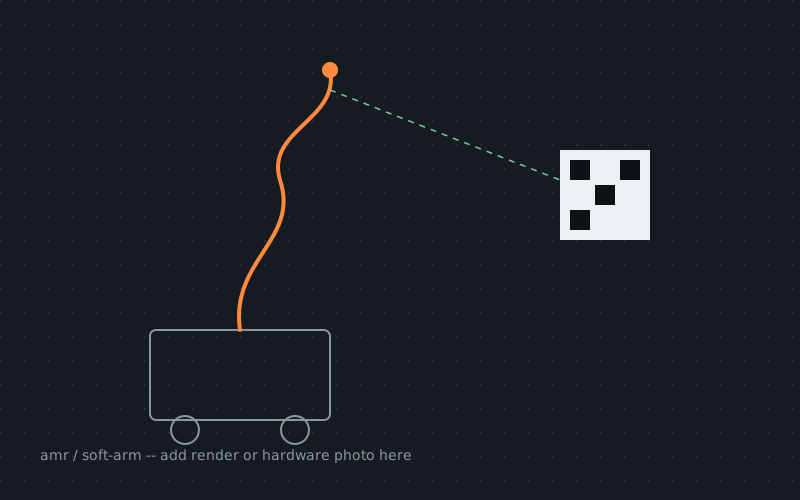
A mobile robot that localizes itself with ArUco markers and manipulates objects with a compliant soft arm, built on ROS2.
RoboticsROS2LocalizationSoft robotics
Stack
ROS2GazeboPythonOpenCVArUcoC++
Problem
Rigid grippers are precise but punishing: a small localization error becomes a collision or a dropped object, especially on a mobile base that isn’t perfectly still when it arrives. This graduation project set out to combine a wheeled AMR with a soft, compliant arm, so that positioning error is absorbed by the arm rather than by the object – while still needing accurate enough localization to know where to reach.
Approach
The system is split into three ROS2 subsystems that talk over standard topics/actions rather than one monolithic node:
- Perception & localization – an onboard camera detects ArUco markers on the
target and the docking station. Marker pose estimation (OpenCV
solvePnP) feeds a filter that fuses vision with odometry, so the robot has a usable pose estimate even when a marker briefly leaves the frame. - Navigation – the AMR uses ROS2’s navigation stack (costmaps + a local planner) to drive from its current pose to a pose offset from the target marker, then hands off to a short vision-servoed final approach for the last centimeters, where dead-reckoning error matters most.
- Manipulation – the soft arm’s compliance is what makes the last step forgiving: instead of solving for a millimeter-perfect end pose, the controller only needs to get “close enough,” and the arm’s own flexibility handles the rest during contact.
Results
- Localization error at the final approach:
[add measured cm error] - Successful grasp/placement rate over
[N]trials:[add %] - End-to-end task time (dock to placement):
[add seconds]
What I’d improve next
- Replace the marker-based localization with a learned pose estimator so the robot isn’t dependent on fiducials in the environment.
- Add closed-loop force feedback from the soft arm instead of relying purely on its passive compliance.